Showing posts with label #heritage. Show all posts

Monday, December 12, 2016

Short Story of a City - Ahmadabad.


Cities were always like people, showing their varying personalities to the traveler. Depending on the city and on the traveler, there might begin a mutual love, or dislike, friendship, or enmity.

Where one city will rise a certain individual to glory, it will destroy another who is not suited to its personality. Only through travel can we know where we belong or not, where we are loved and where we are rejected.

Wednesday, December 7, 2016

Calcutta Chromosomes - Fading Empire


What makes me Travel?  What do I try to see when i Travel? These are all the questions often asked in so many ways and in so many manners to me.

I usually don't like to answer them. I try to show what I see and how I feel but at times I realize that my silence through which I try to speak is half understood.

I travel to see me. Peculiar right? Indeed I often find myself boring and unintelligent in front of a well manicured mirrors in my home. They usually go on chattering the same verbs.

And then a fresh round of air makes me freer from my growing stomach and receding hairline. I travel to find me growing into an exciting homosapien, ignorant to all the best possible presets being applied on my selfies in Instagram.

I become freer from my narcissus tendencies and start looking around for a story. For a story I am unaware of. For a story I will never have to pay a price. For a story that will not yell back at me.

I travel to get soaked in rains, dusted in the muddy air and watch the humans moving endlessly ( at least they would like to believe that ) within the ceaseless singularity of Time.

I Travel to see a drama that will never happen. A piece of history which is so insignificant that none will care for. Peacefully watching the cat crossing the windows, a man chewing the tobacco as if having a sex, an old colonial story of the trams coming to a halt.

Talking about that did I mention that over here in this image I saw General Dyer crying his heart out to this native Indian man and complaining how he will miss riding the Trams!

Yes the bells are ringing. Go and have a ride on these soon to be extinct species of transport from The City of Joy - Calcutta.

Oh, do let me know if Doninique La Pierre would shed some tears hearing the news...

Saturday, December 3, 2016

हसरते... Desires...


"बड़ी हसरत है पूरा एक दिन इक बार मैं अपने लिए रख लूँ
तुम्हारे साथ पूरा एक दिन बस खर्च करने की तमन्ना है !"


I have that strange desire, to keep an entire day hidden from everyone, and keep it to myself ,
and spend it miserly, the way near empty tap does, in painting the moles, on your blue white chest ...


(Sarkhez Roza, Ahmadabad, Gujarat. India).


Short story of a City - Ahmadabad


याद पिया की आये ।


"याद पिया की आये
यह दुःख सहा ना जाये- हाये राम

बाली उमरिया सूनी रे सजरिया
जोबन बीतो जाये- हाये राम

बैरी कोयलिया कूक सुनावे 
मुझ बिरहन का जियरा जलावे 
हाँ पी बिन रैन जगाये – हाये राम"


Oh memories of my beloved haunt me!
Alas, I cannot bear this grief!

I am yet young but my bed is forlorn ;
my youth is passing by – Alas!

The cuckoo, my enemy, coos his song.
Bereft of my beloved, my heart burns.
Yes – I am kept awake all night without my beloved!
Alas!


Background

This is a Thumri but in essence, it is a lament.The song is set to the Hindustani raag Bhinna Shadaj.

Written by the great Maestro Bade Ghulam Ali Khan on the death of his wife who passed in 1932, it has certainly stood the test of time! This is in the Punjabi Thumri style, which is faster paced and sounds generally ‘lighter’ than traditional Thumris.

Translated with a bit of artistic license, he says ‘Oh memories of my beloved haunt me! Alas, I cannot bear this grief!’. He was only 30 when his wife died. ‘I am yet young but my bed is forlorn! Alas, my youth is passing by!’.

Was he crying for himself or his wife? A bit of both, I think. ‘Bereft of my wife, my heart burns’ he says.

I have given a faint try for Transliterating this song and used it over here because the image was composed thinking about this great moment and song


(Street Walk in Old City of Ahmadabad with Cine Prime Lens DS 50mm, 1.5T. )


Friday, December 2, 2016

Short Story of a City - Bhadra Fort, Ahmadabad.


Ahmedabad gets its name from king Ahmed Shah Abdali who ruled and built this formidable city in the 14 the century. Ahmedabad gets its name from king Ahmed Shah Badshah who ruled and built this formidable city in the 14 the century. Ahmedabad is also known by a variety of other names like: Rajnagar, Shrinagar, Amdavad , Ahimdavad, Ahamdavad, Ahamadpur, Akmipur and Ahmednagar. Legendary historian Todalmal and celebrated musician Tansen who were two intellectuals from Badshah Akbar’s court, were actually from Ahmedabad


Thursday, November 24, 2016

Salaam Bombay - The Character of a House (The Magen David)


This house is supposedly older than the first British settlement in Bombay Presidency and dates back to early 1700's when Bombay was governed by the Portuguese and owned by the famous Jewish Trading family.

Now the emblem on the house is called The Magen David ( Shield of David, or as it is more commonly known, the Star of David ) which is the symbol most commonly associated with Judaism today, but it is actually a relatively new Jewish symbol.

It is supposed to represent the shape of King David's shield (or perhaps the emblem on it), but there is really no support for that claim in any early rabbinic literature.The symbol is not mentioned in rabbinic literature until the middle ages.

Scholars such as Franz Rosenzweig have attributed deep theological significance to the symbol.For example, some note that the top triangle strives upward, toward G-d, while the lower triangle strives downward, toward the real world.

Some note that the intertwining makes the triangles inseparable, like the Jewish people.Some say that the three sides represent the three types of Jews: Kohanim, Levites and Israel. Some note that there are actually 12 sides (3 exterior and 3 interior on each triangle), representing the 12 tribes.

While these theories are theologically interesting, they have little basis in historical fact.

The symbol of intertwined equilateral triangles is a common one in the Middle East and North Africa, and is thought to bring good luck. It appears occasionally in early Jewish artwork, but never as an exclusively Jewish symbol. The nearest thing to an "official" Jewish symbol at the time was the menorah.

Isa Khan's Tomb - Arches of the Mughal Architecture.


One of the prominent feature of Mughal architecture directly related to defence are kanguras, or battlements.

Kanguras were not a Mughal invention; they had been around for centuries in India before Babar arrived. In fact, kanguras—in the form of roughly triangular or rectangular shapes—can be seen crowning the walls of early medieval forts in Delhi, including Tughlaqabad.

Well before the Mughals took over, kanguras had become decorative elements of architecture.This is why rows of kanguras can be seen in buildings of a very varied nature, all the way from mosques to tombs, sarais, and (of course), forts and palaces.

{ Kanguras (battlements) atop the main gate of the Agra Fort.}

Another architectural element that had been in use long before the Mughal period was the Pishtaq, or niche . At its most basic, this is a quadrilateral shelf-like niche let into a wall.

These started off (like the kanguras and damaagas) as a practical element of architecture: Pishtaqs could be used as a shelf, to store items, and to hold lamps to illuminate a chamber.Unlike kanguras or damaagas, however, pishtaqs retained their functionality, as a receptacle for lamps.

{This row of Pishtaqs at the Red Fort are in front of the Rang Mahal.}

In pre-Mughal Delhi, for example, Pishtaqs were very common as a form of decoration in mosques. (especially during the era of the Lodhi Sultans).

An example of a highly ornate Pishtaq, from the Lodhi-era mosque at Bada Gumbad (Delhi) and Isa Khan's Tomb in Nizamuddin (Delhi). 

One interesting example of Pishtaqs fulfilling both functional and decorative roles is in garden pavilions. For example, at the Saawan and Bhaadon pavilions in the Hayat Baksh Bagh (at the Red Fort), a series of Pishtaqs carved from white marble cover the front part of the platform.

During the heyday of the Mughals, these Niches used to hold silver vases filled with golden flowers during the day, and burning lamps at night: a pretty sight indeed.

{In Delhi's Hayat Baksh Bagh, a view of cusped arches and a chadar, at one of the garden pavilions.}

Garden pavilions also often incorporated another important feature of Mughal architecture, the Chadar.

Chadar is a stone slope which acts as the bed for a water channel when it descends from a higher level to a lower one.The chadar is lightly carved with a pattern of shallow scallops or similar repetitive patterns.Water flowing over these ripples pleasingly.

{A Chadar - a carved slope for a water channel - at Red Fort and Isa Khan's Tomb.}

Lastly, one architectural feature that is not just typically Mughal, but can actually be traced back quite specifically to Shahjahan’s reign.

This is the ‘ Daantedaar Mihrab ’, also known as the denticular arch , the scalloped arch , or the cusped arch , because it consists of a series of semi-circular scallop-like cut-outs that form the inside of the arch.

{An example of a cusped arch - at Safdarjang's tomb, Humayun's Tomb.}

Some believe that Shahjahan himself invented the daantedaar mihrab ; at any rate, it is also commonly called a Shahjahani arch

Calcutta Chromosomes - Colonial Stories

Tuesday, November 22, 2016

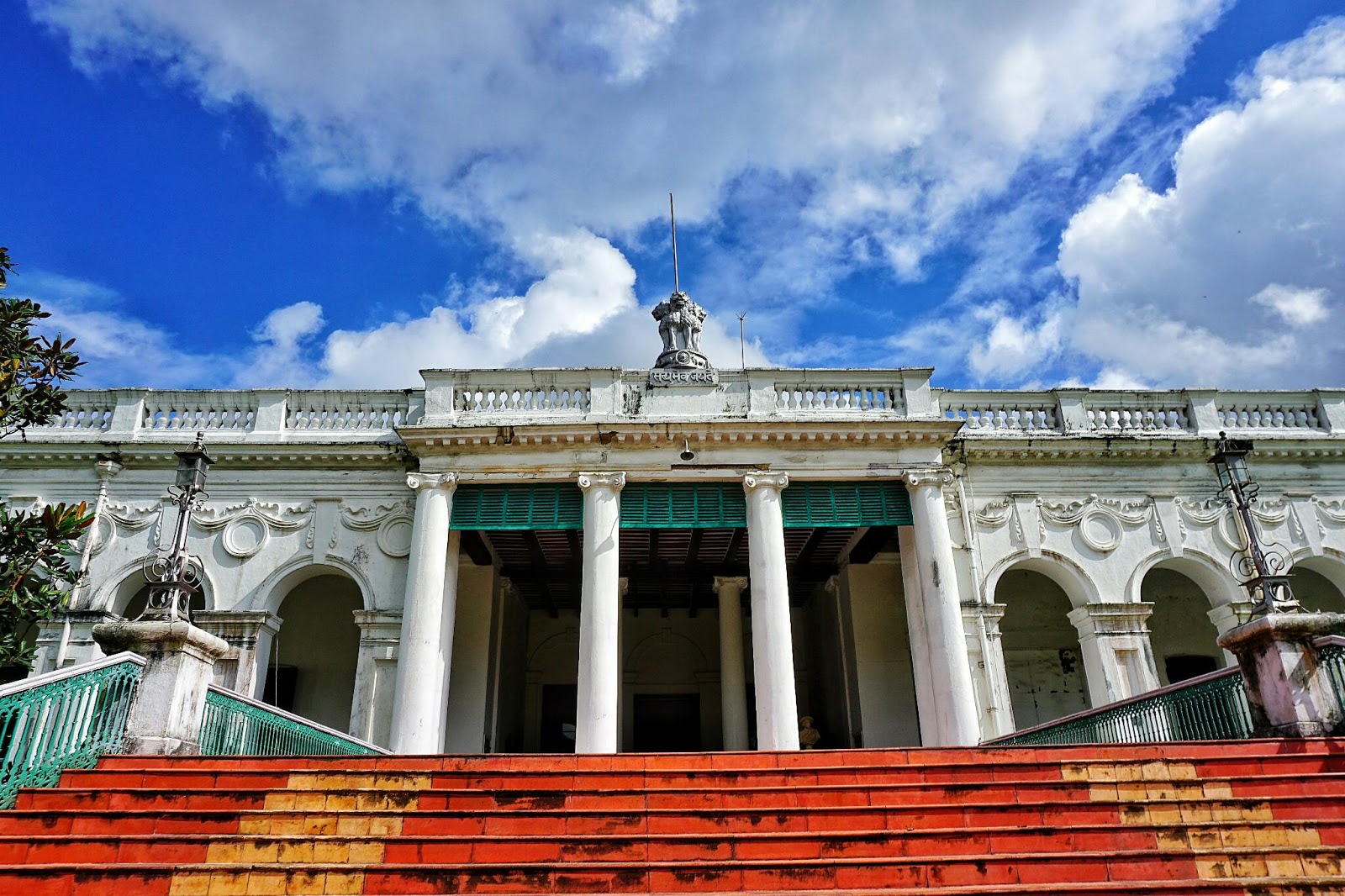
Calcutta Diary - The National Library

The city defeated me. It refused to be bent into shape; it stayed a willful, sprawling, sinful place. It even told me as much. When i walked through the gutted wreck of old building of National Library , i tripped and fell over a piece of rubble -- a graying stone. When i got to my feet and dusted myself down i saw that it read, in Latin, 'Resurgam' -- 'I Will Rise Again'...

Calcutta Diary - The Tramways

Monday, November 21, 2016

Calcutta Diary - The National Library

The Rusty Ruins were the remains of an old city, a hulking reminder of back when there'd been way not too many people, and everyone was incredibly intelligent. And Brilliant in their love for knowledge, and that which helped them outgrow slavery and build a design - of a Nation!